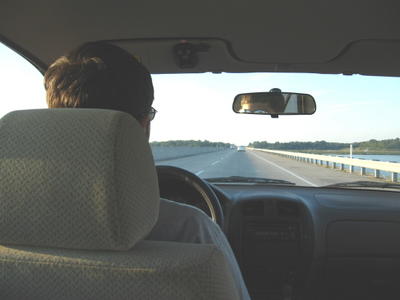
When I was in high school I received one of the greatest gifts possible--a job that I desperately didn't want to make into a career. The summer I turned sixteen I was having trouble finding places that would hire someone my age, and so a contractor friend of the family offered me a job on his crew. I learned a lot from the experience, as I worked there the next three summers, but frankly most of it had to do with how I was not well-suited to working in construction.
The primary lesson regarding my incompatibility with construction had to do with the fact that didn't, and I still don't, do well working in the elements. I recall one specific roof that we worked on on a day that was closer to 110 °F than 100 °F. The sun was unrelenting, and it sapped the energy from the body as we did anything. One of the guys in the crew who took a lot of pride in his work ethic got wobbly at one point, and had to take a long break in the shade on the ground. It was impossible to do anything for more than a couple of minutes without downing a huge gulp of water, because we were sweating it out faster than it could be drunk. I distinctly remember riding home from that job thinking that I clearly cannot do this for the rest of my life.
As bad as hot days were, the cold days were worse. We didn't work many cold days, but I would help on random jobs in the spring or autumn. I remember siding a house on a breezy October day wondering why anyone would put themselves through that. At some point I couldn't reliably use my hands because they were too numb. I cannot imagine how someone working construction outside on a winter day must feel.
I think about these situations a lot on days that are very hot or cold. I am fortunate to have the opportunity to work in an office setting with a controlled climate. That fact alone is worth the effort and expense I put into my education, and I am fortunate enough to know that I am fortunate.
A secondary lesson I received from that job was the fact that I realized that I am a klutz. I have to have a job away from dangerous equipment, because otherwise I'll eventually hurt myself or someone else badly. In the short time I was there I was able to observe that I got more cuts and bruises than the rest of the crew. I have at least one scar from that period of time in my life, and I was fortunate it was as minor as it was. I understood very quickly that it was only a matter of time before something very bad happened. This was compounded with the fact that I took more chances on scaffolding than I probably should have. My boss confessed to my parents once about watching me nervously on a scaffold, I assume it was from concern that I'd take a misstep from two stories up.
I didn't really need extra motivation to stay in school. There was no chance of me quitting once I started, and it's the setting where I've always done best. However, having a job like that, which I worked even through my freshman year in college, provided quite a bit of clarity regarding the sort of life I did not want to have, and the choices I needed to make to keep from going down that path. There are probably a lot of people who don't have that opportunity, and they make life decisions without that same clarity. I can now, twenty years after the fact, say that this clarity was a blessing.
Thursday, March 14, 2019


Thursday, March 07, 2019
self made
Twitter lit up a couple of days ago regarding Forbes declaring Kylie Jenner the youngest self-made billionaire, reaching that level at the age of 21.
I'll confess. My gut reaction was the same as what a lot of other peoples' reaction was. She started as a millionaire with every possible advantage available to her. How "self-made" can we possibly call her? In thinking through the logic of this assertion, I hit on what I believe are a few uncomfortable truths that a lot of people don't like to think about when comparing themselves to others.
Truth #1 - No one is self-made
While it is true that there is a sliding scale to how self-made a person is, the reality is no one is truly self-made, and I doubt many are even in the general neighborhood. If you're even mildly successful in some area of life I can guarantee that many of the factors in that are gifts that were beyond your control. I considered typing examples of this, but it's so specific to the person and the examples are usually embarrassingly obvious.
The response that most people would give to this is that, sure, I have some advantages in life, but not anywhere near the advantages Ms. Jenner has been given. Perhaps this is true, but there are billions of people who don't have the advantages that I've been given in life. In my moment of taking credit away from her I'm also thinking in the back of my mind that I've worked for and earned what I have.
Truth #2 - I am responsible for the opportunities I pass up
The reality is that I wouldn't have become a billionaire if I were Ms. Jenner. I like to think that I would have made something of the opportunities would have had in her shoes. I'm deluding myself to think that my grit and smarts would have outperformed hers. Yes, she had every opportunity, but she also clearly used it.
I have to acknowledge that my life, like everyone else's, is marked by a series of choices I have made to do or not do certain things. There are times when I have chosen a path that led to growth, and there are times when I have not. There are times when I made actively destructive decisions.
Whether I have the maturity to make a wise choice is always on me.
Truth #3 - We value people too much for their wealth
While accruing a billion dollars in wealth is significant and noteworthy, this doesn't say anything about Ms. Jenner as a person. The size of her bank account or assets alone doesn't validate or invalidate her as a person.
None of this is shocking, new, or particularly insightful. However, I find that I constantly want to go back to the same broken patterns I see others stuck in. So much of life is spent building a career with the intent to generate an income that it's easy for that to be my identity. It's then easy to compare the life that my resources allow me to have to the lives others have, then to let that determine my value.
So, when someone is shown to have accrued wealth it is easy to think of that wealth as a gauge of their worth, and whatever I have accrued as a gauge of my worth. I know it's wrong. Most people factually understand this. I also know I'm not the only person who naturally falls into this mindset, and has to combat it.
So, Ms. Jenner does deserve some congratulations on this milestone. It's significant! But, it doesn't make her a more or less significant person. If she loses her wealth and everything else tomorrow she's no more or less valuable of a person than today as a billionaire. That's a truth I find both the easiest and the hardest to believe.
Wednesday, February 27, 2019
february christmas lights
Over the last couple of weeks I noticed a handful of houses around my neighborhood and some of the areas I drive regularly finally take down their Christmas lights. This wasn't a situation where the lights were up but not on. The lights were turned on every evening like it was Christmas season.
I have also noticed that an office in my building has a Christmas tree up in a meeting room visible from a public hallway. I haven't seen it lit in a few weeks, but it is still prominently displayed.
Part of me is irrationally irritated at this. However, my irritation doesn't make sense. If someone wants to leave lights up it isn't my business, and really Christmas displays are attractive. It's just that seeing Christmas displays feels incongruous with the season.
I think this part of me is a little hypocritical as well. I have believed and continue to believe that certain fashion rules are made to be broken. This shouldn't be any different, right? Is a lit Christmas display in February the equivalent of an all-white outfit in November?
Wednesday, February 20, 2019
cherokee princess
From when I was born until when I was elementary-aged my dad worked on a few different reservations. We are as white as white can be, and no one in our family ever pretended any different. It never crossed my mind to think any differently about the situation, either. However, one of the first questions I'd get from people who did not live near the reservation was whether I had any Native American ancestry. This was almost always a prelude to someone telling me about their grandparent who was half-blooded [fill in Native American tribe].
Even as a kid, this pattern jumped out to me because it happened so often. Why did people who had probably never been on a reservation care so much to identify with a specific tribe? In my experience (from the 80s and early 90s) reservation life was different from life off the reservation in a lot of respects, so it felt a little like trying to gain the benefits of an identity without paying in experience.
I don't remember this firsthand, but there's apparently a joke that gets told among Native people about how every white person's grandmother was a Cherokee princess. That does fit my experience. Everyone and their brother seemed to want to tell me about their Native ancestor. In fact, even if I mention now that I used to live on a reservation to a small group of people it is more or less guaranteed that someone in the group will notify me of their Native American heritage.
This is what has made the evolving story surrounding Elizabeth Warren fascinating to me. I don't doubt that she fully believed that she could claim Native American ancestry. I've heard enough people who were convinced of it themselves that it fits the pattern. Why, just based on family stories, she decided she should assert that as an identity baffles me. Even if she had a close Native ancestor, she clearly had to know that she was mostly Caucasian and lived a Caucasian life. She should have especially known that as someone who originally hailed from Oklahoma. Of all of the unforced errors a [future] politician could commit, this is among the dumbest.
However, as dumb as I think that scandal is, my experience says that Warren doesn't go much further than a lot of other Native American wannabes. I am certain that a lot of the folks laughing about "Pocahontas" Warren's claims have also asserted their non-existent Native heritage whenever they got the chance. The reason I'm so sure is that I've probably heard one of them talk about their Cherokee grandparent some time in the past.
Tuesday, February 12, 2019
1000
After nearly fourteen years, this is my 1000th article on this blog. Since another word for thousand is "grand" I've compiled a few "grand" facts.
- "Grand" originally came from the French "grant." Then, as now, it meant large or powerful. [source]
- The name for the 100 grand bar (originally, the $100,000 bar) was inspired by the popularity of quiz shows in the 1950s. [source]
- The Grand Slam tournament in tennis, which is a sport I hardly know anything about, includes four events across three continents. [source]
- Alex Rodriguez set the major league baseball record for grand slams with an astounding twenty-five during his career. This is one of those records that requires both individual skill and the fortune to have teammates who put you in a situation where a grand slam is a possibility. [source]
- While a Grand Teton National Park in Wyoming was founded in 1929, the current park includes large portions of land that were donated years later by John D. Rockefeller, Jr. [source]
- The Republican moniker "G.O.P." now stands for "Grand Old Party." However, it originally stood for "Gallant Old Party." [source]
- On average, two or three people die from falling into the Grand Canyon every year. However, since millions of people visit a year it has to be considered a safe place to visit, statistically speaking. That said, I would be uptight about the possibility if we visited it with our kids. [source]
- Gerald Ford grew up in Grand Rapids, Michigan. He holds the distinction of being the only U.S. president to hold the office without having been elected either president or vice president. [source]
- There is a World War II power station underneath Grand Central Terminal in Manhattan, New York. It was placed there to protect it from German sabotage during the war. [source]
- The first piano created was a grand piano by Bartolomeo Cristofori in Italy in the late 1600s or early 1700s. It was originally known as the "pianoforte," which means "soft" and "strong." It differed from the harpsichord before it in that you could modulate the volume of the instrument based on how forcefully or lightly you struck the keys. [source]
- The "grand theft" in "grand theft auto" refers to the fact that what is being stolen is valuable. "Petty theft" refers to the theft of less valuable items. [source]
Monday, February 04, 2019
lessons at the mechanic
When I was at the mechanic a few days ago waiting to have the brake pads battery replaced on my car I noticed that there wasn't really a way to avoid hearing chatter around me. I especially heard the conversations that other people had with the representative from the dealership who were explaining what they found wrong with their cars.
One man was told that he needed to replace his tires with a set that cost $800, but he declined to do so due to the lack of funds. An older lady was told she needed to replace her battery, and was confused that it wasn't covered by her warranty. Another man was informed that he had nails in two different tires, but that the fix was cheap and quick.
As a parent, it occurred to me that these are the sort of situations that I need to be training my kids to handle one day.
In the example of the first man, if you have a car or anything else that is expensive it will cost money to maintain. Failing to budget for those expenses leads to inevitable unpleasant surprises. I never really appreciated that at a younger age, and I certainly didn't maintain my vehicles as well a decade and a half ago as I do now. We have had some unpleasant surprises over the years related to the cars.
In the example of the older woman, my initial reaction was to think that of course the battery is not under the car's warranty. However, that is not necessarily an intuitive fact to know. Why is the alternator something that would be under warranty (which the representative explained to the lady) but the battery isn't? I know it's because the battery is guaranteed to need to be replaced, but an older lady may not understand this. The kids need to understand that the stuff that is covered by warranty is almost always the stuff that is least likely to need to be replaced. Warranties are useful, but they are also frequently written so that you still have to pay to fix the thing under warranty.
In the example of the last man, sometimes what sounds like bad news may actually be good news. Had he not discovered the nails he may have had to replace the tires, but he was able to get them plugged cheaply. Don't always expect bad news, and appreciate the good news when you get it.
The sorts of things you need to understand to manage in life aren't always what you learn in school. It's hard as a parent to remember that there are lessons to learn everywhere.
Tuesday, January 29, 2019
family tree
I think everyone is interested in where they came from, but I've been much more in the years since we had kids. Through the diligent work of various family members in researching, and the efforts of my mom in putting that research together in one place, I've learned a lot about different branches of my family tree that I did not know before.
One branch that I knew very little about bothered me quite a bit because it is the branch that my surname comes from. I have always known my paternal grandfather father's name, but didn't know anything about him. Furthermore, my dad only had limited contact with that side of the family when he was a kid, and so it felt like the source of my name ended with that one individual that I knew nothing about.
It's amazing how learning one or two small details about a person can fill in a lot of facts that you don't already know. I recently discovered further information about this great-grandfather that makes his life seem both tragic and fascinating, but the details are minimal.
First, I found out that my great-grandfather was his father's fifteenth child to his third wife. Both of his parents died before he was a teenager, so he was raised by a sister. His father had been a devout Quaker, but I don't know if the family's faith or just the era in which they lived more influenced why he kept remarrying after his wives died and having more kids.
My understanding is that my great-grandfather was irreligious for most or all of his life--a seeming oddity in southwestern Missouri in the early 1900s--and I wonder if he blamed his father's faith for being without parents at a reasonably early age. While most kids were expected to take on adult responsibilities at an earlier age in those days, I have to wonder how that affected him. He would have had to grow up fast.
Second, I found out that my great-grandmother (my paternal grandfather's mother) died eighteen years prior to my great-grandfather. This calls to mind something that my mind does every time I'm at a cemetery. I look at the gaps between when spouses died and I imagine what their lives were like when they were together, then what sort of life the surviving spouse had afterward. I know it's morbid, but I can't not do it.
I asked my dad what he knew about his grandfather's life during those eighteen years, and he said he lived alone in a very small house near the Missouri/Oklahoma border with a dog. I asked if he were a reader, and my dad didn't recall that he was. What does a person do for eighteen years without someone else around? Nowadays, I can imagine being able to get on by yourself with TV, the Internet, etc. However, I cannot imagine a life of that sort of solitude and minimal outside stimuli.
So, with a few additional data points that I have learned in the last few months I have generated quite a vision of how one of my ancestors lived. It's a sad vision, but it's far more significant than a name on a line in a tree.
Subscribe to:
Posts (Atom)